
GICv3 & GICv4
GIC Overview
GIC stands for ‘Generic Interrupt Controller’. For a summary, please refer to GIC summary.
The GIC is an ARM-specific interrupt controller provided by ARM.
This document covers GICv3 and its virtualization extension, GICv4.
A representative software example is the Linux Kernel.
Please refer to IRQ management in Linux kernel for related content.
Introduction
An Interrupt Controller is literally a device that controls interrupts.
When it receives an interrupt signal from an external device,
it plays the role of delivering it to the appropriate PE (Core).
GICv3 introduced significant scalability improvements (LPIs, affinity routing) and a System Register interface for the CPU.
GICv4 builds upon GICv3, adding hardware support for Direct Injection of virtual interrupts (vLPIs) to Virtual Processing Elements (vPEs), significantly reducing virtualization overhead.
The components of the GIC are as follows:
1. Distributor (GICD)
2. Redistributor (GICR)
3. CPU-INTERFACE (ICC)
4. ITS (optional, GICv3+)
GIC Components
Broadly, there are:
Distributor , (SPIs route, global configuration)
Redistributor , (SGIs, PPIs, LPIs route, per-core management)
CPU-INTERFACE , (Interface to the PE)
ITS , (Translate LPIs).
Distributor (GICD)
The Distributor performs the role of distributing SPIs requested by on-chip devices or external devices.
It manages interrupt priorities and routing for SPIs.
It is Memory-Mapped.
Redistributor (GICR)
The Redistributor plays the role of handling SGIs, PPIs, and LPIs.
It is located closer to the Core (PE) and allows for distributed design.
For LPIs, it accesses memory where the pending/configuration tables are stored.
It contains the GICR_WAKER register for power management.
It is Memory-Mapped.
CPU-INTERFACE (ICC)
The CPU interface delivers the physical interrupt signal (IRQ/FIQ) to the Core and handles the Core’s acknowledgment (ACK) and End-of-Interrupt (EOI) signals.
In GICv2, it was memory-mapped.
From GICv3, the CPU Interface is accessed via **System Registers**.
This reduces bus traffic and enables faster context switching.
To access these registers in the Trace32 debugger, you must use the SPR: class.
Examples: ICC_IAR1_EL1 (Interrupt Acknowledge), ICC_PMR_EL1 (Priority Mask), ICC_EOIR1_EL1 (End of Interrupt).
ITS (Interrupt Translation Service)
It plays the role of translating the messages of message-based interrupts (MSIs).
It is supported from GICv3 (optional but common in PCIe systems).
It translates (DeviceID, EventID) into (Collection, INTID) using tables in memory.
DT: Device Table (DeviceID -> ITT Base)
ITT: Interrupt Translation Table (EventID -> INTID, CollectionID)
CT: Collection Table (CollectionID -> Target Redistributor)
The translated information is loaded into system memory.
This information must be verified through actual kernel code analysis.
Interrupts
The status of an interrupt is determined by signals from the GIC and the Core.
‘Inactive’, ‘Pending’, ‘Active’, ‘Active & Pending’
The interrupt status change is determined by the interrupt type:
- Level sensitive
- Edge trigger
Interrupt types are optional, but SGI and LPI are mostly Edge triggered.
Regarding Level sensitive, SPI is Active HIGH, and PPI is Active LOW.
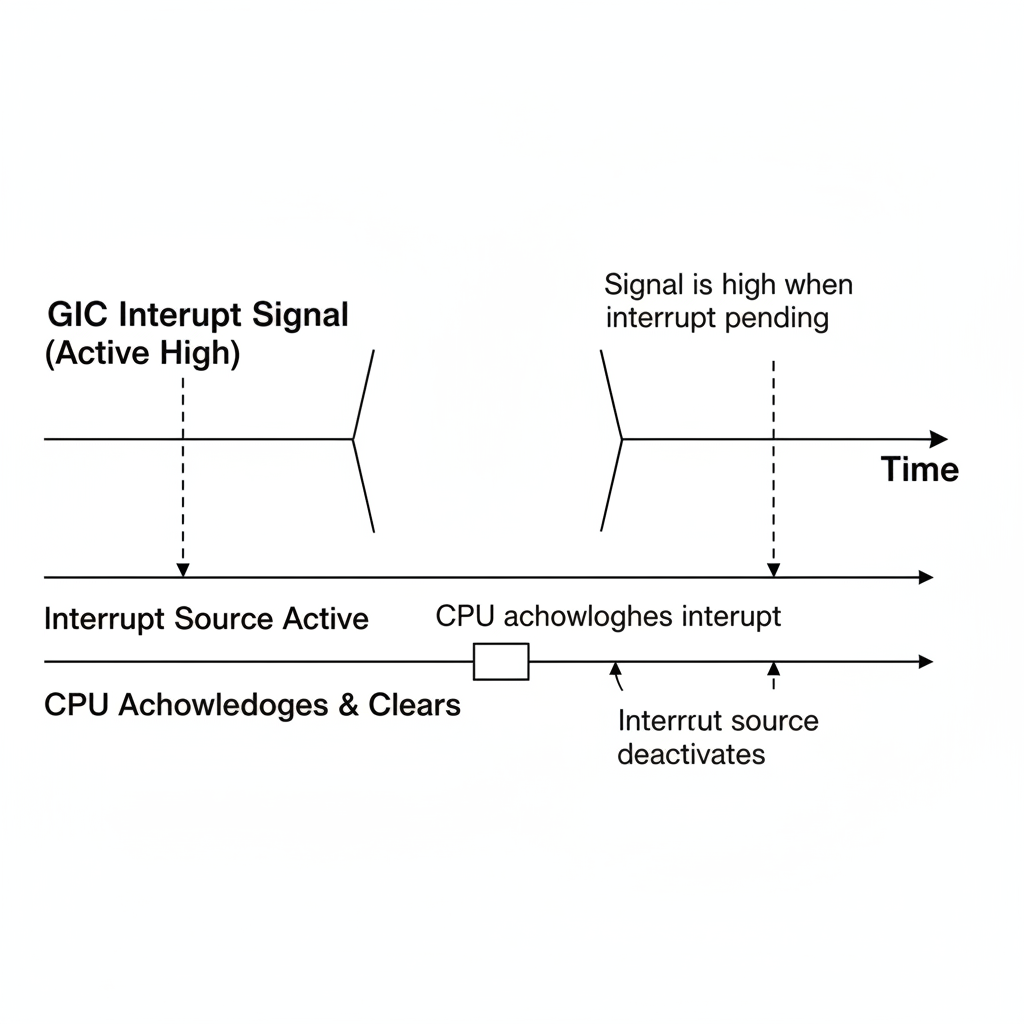
Picture [1] GIC level sensitive
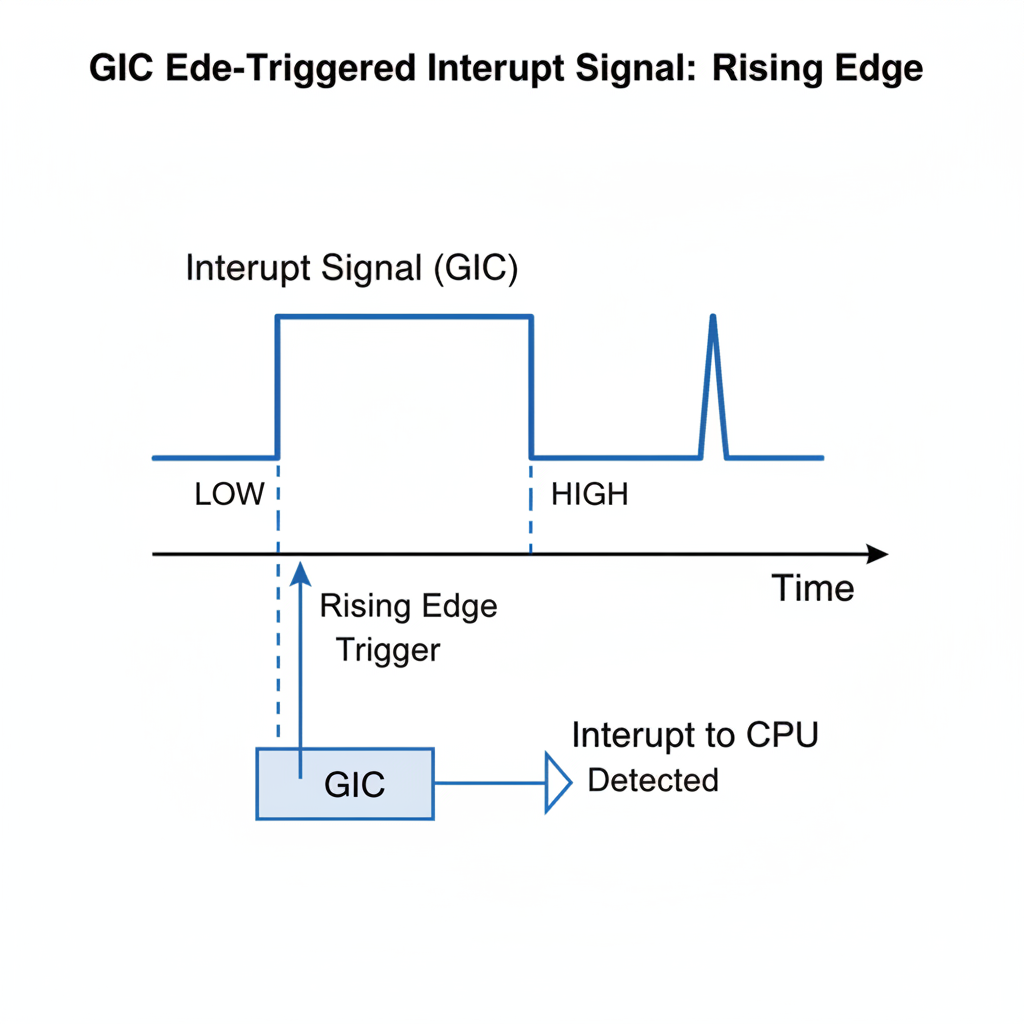
Picture [2] GIC edge trigger
Interrupt Groups and Security
Interrupts are managed in groups for security (TrustZone):
- Group 0: Secure interrupts (FIQ to EL3).
- Secure Group 1: Secure interrupts (IRQ/FIQ to Secure EL1).
- Non-secure Group 1: Non-secure interrupts (IRQ to Non-secure EL1/EL2). Typical Linux interrupts.
Interrupt Types
SGIs (Software Generated Interrupts)
- IDs: 0-15
- Used for Inter-Processor Communication (IPI).
- Classified as hardware interrupts in Linux.
PPIs (Private Peripheral Interrupts)
- IDs: 16-31
- Private to a specific core (e.g., Generic Timer, PMU).
- ID 25 is typically used for the Virtual Maintenance Interrupt (VMI) in GICv3/v4 virtualization.
SPIs (Shared Peripheral Interrupts)
- IDs: 32 - 1019
- Shared by all cores. Routing is configured by the Distributor.
- Verify interrupts using
/proc/interruptsand Trace32 (checkingISACTIVRandISPENDR).
LPIs (Locality-specific Peripheral Interrupts)
- IDs: 8192 and above.
- Message-based (MSI/MSI-X).
- Always Non-secure Group 1.
- Edge-Triggered only.
- Configuration and Pending state are stored in Memory Tables, not registers.
LPI Check conditions:
/* LPI configs */
1. GICD_CTLR.DS == ? (0 or 1)
2. GICR_CTLR.EnableLPIs == 1
3. GICR_TYPER.CommonLPIAff (Optional)

/* Address infomation */
1. GITS_BASER (memory structure)
2. GITS_CBASER (ITS command queue)

/* LPI tables */
1. GICR_PROPBASER (Configuration Table)
2. GICR_PENDBASER (Pending Table)
GICv4: Direct Injection
GICv4 is an extension designed to optimize virtualization.
In GICv3, injecting a virtual interrupt (vIRQ) to a Virtual Machine (VM) requires:
- Physical interrupt traps to Hypervisor (EL2).
- Hypervisor writes to List Registers (LRs) in the GIC.
- GIC asserts vIRQ to the vCPU.
This “Trap-and-Emulate” model has high overhead.
GICv4 allows Direct Injection:
- ITS translates an incoming MSI directly into a vLPI (Virtual LPI).
- The hardware checks if the target vPE (Virtual PE) is scheduled.
- If scheduled, the hardware injects the vLPI directly to the vCPU without Hypervisor intervention.
- If not scheduled, it is recorded in a vPE Table in memory.
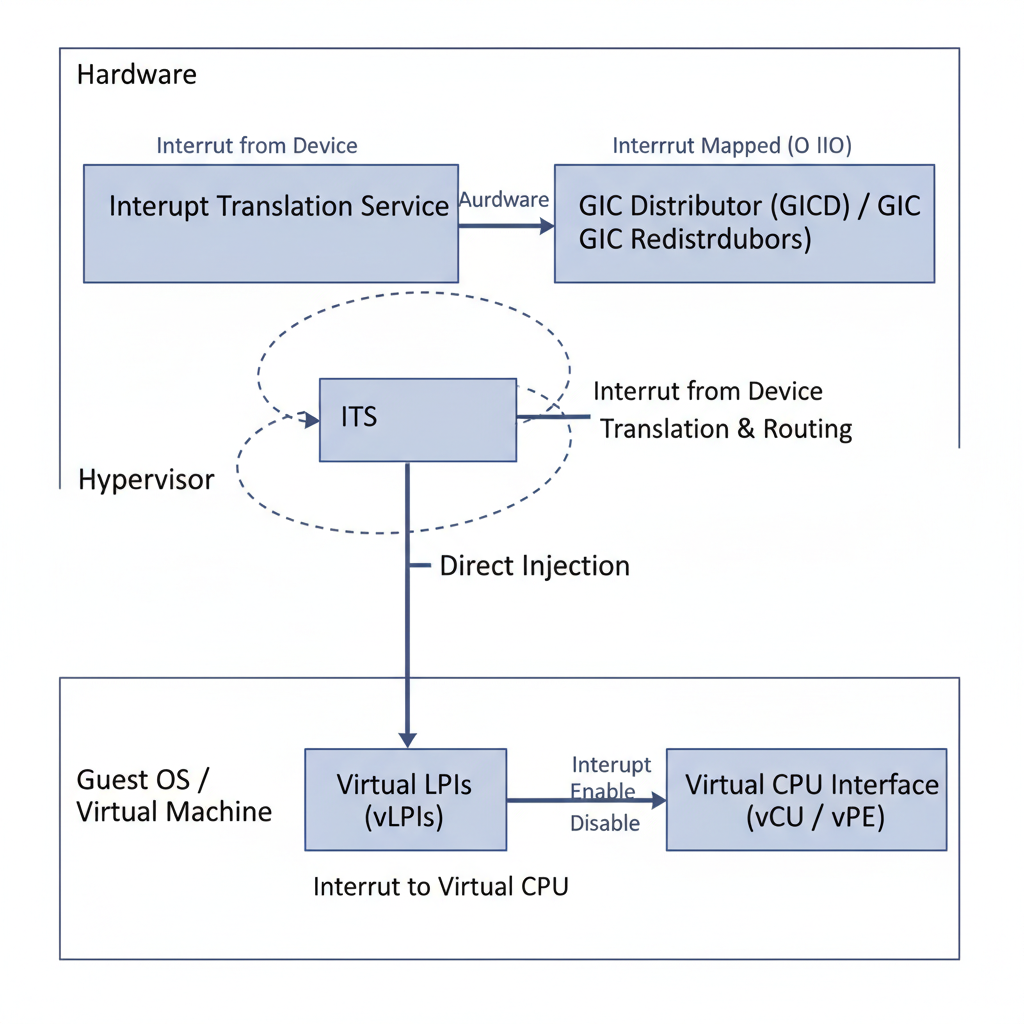
Picture [3] GICv4 Direct Injection
This significantly reduces CPU overhead for network and storage virtualization.
Power Management
GICv3/v4 introduces a handshake mechanism for power management using the GICR_WAKER register in the Redistributor.
- ProcessorSleep: When a core is about to enter a low-power state (e.g., idle), it sets the
ProcessorSleepbit. - The GIC ensures all pending interrupts for that core are forwarded or handled.
- ChildrenAsleep: When the GIC is ready, it asserts
ChildrenAsleep. - The core can now safely power down.
On wake-up, the core clears ProcessorSleep, and the GIC resumes interrupt delivery.
Programmer’s Model Summary
| Component | Access Type | Note |
|---|---|---|
| Distributor | Memory Mapped | Global settings, SPI routing. |
| Redistributor | Memory Mapped | Per-core settings, SGI/PPI/LPI management. |
| ITS | Memory Mapped | Translation services (MSI). |
| CPU Interface | System Registers | Accessed via MSR/MRS. Low latency. |
Important System Registers:
ICC_PMR_EL1: Priority Mask Register (Set interrupt threshold).ICC_IAR1_EL1: Interrupt Acknowledge Register (Read to get INTID).ICC_EOIR1_EL1: End of Interrupt Register (Write INTID to finish).ICC_CTLR_EL1: Control Register.
References: